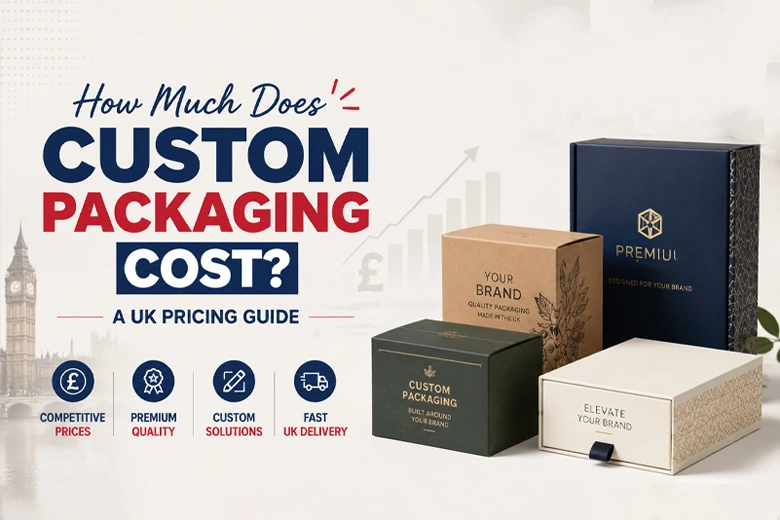
Custom packaging in the UK can cost anywhere from £0.20 to more than £15 per unit, depending on the packaging style, material, quantity, printing, and level of customisation. For most businesses, standard custom boxes usually cost between £0.50 and £4 per box, while premium rigid boxes, luxury gift packaging, and boxes with special finishes can cost significantly more.
The reason custom packaging prices vary so much is that every product has different requirements. A small folding carton for cosmetics will have a very different cost compared to a luxury rigid box for premium gifts or a strong mailer box designed for e-commerce deliveries.
More businesses are choosing custom packaging as standard packaging mostly creates problems. Sometimes a ready-made box is too large for the product, requires extra filling materials, increases delivery costs, or fails to provide enough protection. Custom boxes are designed around the exact size and needs of your product to save you from this hassle.
However, the prices shown on the supplier’s website are not the complete packaging cost. Businesses also need to consider additional expenses such as design, samples, tooling, deliveries, VAT, and import charges where applicable.
In this guide, we will explain the average cost of custom packaging in the UK, the factors that affect pricing, hidden costs to consider, and practical ways to get high-quality packaging without overspending.
Custom Packaging Cost at a Glance
The following prices are generally estimated to help you plan your packaging budget. Actual costs depend on the size, material, quantity, printing method, and custom features.
| Packaging Type | Estimated Cost Per Unit |
| Folding Cartons | £0.20-£2.50 |
| Custom mailer boxes | £0.60-£4.00 |
| Corrugated shipping boxes | £0.80-£7+ |
| Custom paper bags | £0.15-£3.50 |
| Rigid gift boxes | £2-£12+ |
| Luxury magnetic boxes | £2-£12+ |
| Stand-up pouches | £0.25-£1.80 |
A simple printed box with minimal customisation will usually sit at the lower end of the range. A premium box with inserts, foil stamping, embossing, or luxury materials will cost more.
Why Is There No Fixed Price for Custom Packaging?
Unlike standard stock boxes, custom packaging boxes are manufactured specifically for a brand and product. Even small changes in size, material, or design can affect the final price.
For example, two UK businesses ordering 1,000 boxes may receive completely different quotes. A candle brand may choose a simple printed carton with basic artwork. A luxury skincare company may need a rigid box with a magnetic closure, foil logo, and custom insert.
Both businesses are ordering custom packaging, but the second option needs more materials, labour, production steps, and finishing work.
A realistic packaging quote should consider:
- Manufacturing cost
- Design charges
- Sampling cost
- Tooling and setup fees
- Delivery costs
- VAT or import charges where applicable
The cheapest box price does not always mean the lowest overall cost. The goal is to choose packaging that protects your product, supports your brand, and makes financial sense.
Main Factors That Affect Custom Packaging Cost
1. Packaging Type and Material
Every packaging type is different. That is why the type of packaging you choose has one of the biggest impacts on cost.
Folding cartons are usually one of the most affordable options. They are lightweight, easy to store, and commonly used for cosmetics, food products, candles, supplements, and small retail items.
Mailer boxes are stronger and designed for direct-to-customer deliveries. They are popular with e-commerce businesses because they provide protection while improving the unboxing experience.
Rigid boxes are premium packaging options. They are made from thick boards covered with decorative paper and usually involve more manual production work. They are often used for luxury products, jewellery, electronics, and gift packaging.
The material also affects the final price. Kraft board, corrugated board, rigid board, and flexible packaging materials all have different costs based on strength, appearance, and manufacturing requirements.
Be thoughtful while choosing the materials, as the cheapest material is not always the best decision. Poor-quality packaging can lead to damaged products, returns, and negative customer reviews, all of which costs you even more.
2. Box Size and Dimensions
The size of your packaging directly affects the cost because larger boxes require more material. Even a small change in dimensions can impact pricing. Manufacturers need to arrange packaging designs efficiently on sheets of cardboard or paperboard. Poorly planned sizes can increase material waste.
Also, box sizes affect delivery costs. Larger packages take up more storage space and may increase courier charges. A correctly sized custom box can help businesses:
- Reduce material usage
- Lower delivery costs
- Reduce unnecessary filling materials.
- Improve product protection
For growing brands, designing packaging around the product size can create savings beyond the initial box price.
Order Quantity and Minimum Order Quantity (MOQ)
Most of the packaging suppliers allow customers to order from their minimum order quantity. The quantity you order has a major effect on the price per box. Custom packaging includes fixed setup costs such as:
- Artwork preparation
- Machine setup
- Printing preparation
- Die creation
- Quality checks
When these costs are divided across a small order, each box becomes more expensive. For example, if setup costs are £500:
- 100 boxes add £5 per box
- 1,000 boxes add £0.50 per box
- 5,000 boxes add only £0.10 per box
This is why larger orders usually have lower unit prices. However, ordering too much packaging is not always a good idea. If your branding, product size, or design changes, you may be left with unused stock.
Many UK packaging suppliers offer smaller quantities through digital printing, while larger traditional print runs usually require higher minimum order quantities. If your packaging quantity is very limited, we at Custom Box Makers UK offer no minimum order quantity.
Printing, Colours, and Special Finishes
Printing choices can significantly affect packaging costs. A simple logo printed on a kraft cardboard will cost much less than a full-colour artwork covering the entire box. Cost usually increases with:
- Full-colour printing
- Inside printing
- Multiple designs
- Pantone colour matching
- Large print coverage
Premium finishes can also increase prices. Look at the table below for a clear understanding:
| Feature | Typical Cost Impact |
| One-colour printing | Lowest |
| Full CMYK printing | Medium |
| Foil Stamping | Higher |
| Embossing | Higer |
| Spot UV | Moderate to high |
These features can make packaging look more premium, but they should be used carefully.
For example, a small foil logo can create a luxury appearance without the cost of applying premium finishes across the entire box.
Inserts, Design, and Samples
Custom inserts are useful when products need extra protection or a premium presentation. Common insert options include:
- Paperboard inserts
- Corrugated inserts
- Foam inserts
- Molded pulp trays
The cost depends on the material, shape, and complexity.
Packaging design is another cost businesses mostly overlook. Some suppliers only include basic artwork placements, while complete packaging design may require additional investment.
Professional packaging design includes:
- Structural design
- Artwork creation
- Dieline preparation
- Brand concepts
- Print-ready files
Before placing a large order, always request samples. A sample allows you to check product fit, print quality, strength, colour accuracy, and overall presentation. A small sampling cost is usually much cheaper than replacing thousands of incorrect boxes.
Shipping, VAT, and Hidden Costs
Supplier location can influence the overall cost of custom packaging. While overseas manufacturers may offer lower factory prices, the final cost depends on additional expenses that vary from one supplier to another.
Ordering from overseas may involve international shipping charges, import duties, VAT, customs clearance, currency exchange fluctuations, and longer lead times. These costs can increase the total amount paid beyond the quoted unit price.
UK suppliers may have higher manufacturing costs in some cases, but local production can reduce shipping distances, simplify communication, and shorten delivery times. Depending on the order size, packaging specifications, and delivery requirements, these factors may affect the overall cost of the project.
When comparing quotations, it is important to look beyond the price per box and consider the complete cost, including production, shipping, taxes, and additional charges, before making a decision.
How to Calculate the Real Cost of Custom Packaging?
A simple formula is:
Total packaging cost ÷ Number of usable packages = Actual cost per package
A UK candle company orders 500 custom candle boxes.
- Box manufacturing: £600
- Design: £250
- Tooling: £150
- Delivery: £200
Total cost = £1,200
Actual cost = £1,200 ÷ 500
= £2.40 per box
Although the supplier’s manufacturing price was mentioned as £1.20 per box, the true first-order cost is £2.40.
However, the prices for future orders may be lower because design and tooling costs are already part of it.
How to Reduce Custom Packaging Costs?
Keeping packaging costs under control is not always about choosing the lowest-priced box. Small changes to your packaging specifications and ordering strategy can often reduce overall costs without affecting product protection or presentation.
Choosing dimensions that closely match your product can reduce material usage, minimize the need for void fill, and lower shipping expenses. Comparing prices across different order quantities can also reveal significant savings, as unit costs mostly decrease with larger production runs.
Using standard box structures instead of fully bespoke designs may help you reduce tooling and production costs. Similarly, premium finishes such as foil stamping, embossing, or spot UV should be selected where they add genuine value rather than applied unnecessarily to the full box.
Requesting samples before full production provides an opportunity to verify the fit, print quality, and construction, helping you avoid costly errors later. Finally, when comparing suppliers, review complete quotations rather than unit price alone to make sure they include the materials, specifications, delivery terms, and additional charges.
Questions to Ask a Custom Packaging Supplier
Before ordering, ask your packaging suppliers these questions to avoid costly mistakes:
- What material thickness is included?
- Is tooling included?
- Are samples included?
- What is the minimum order quantity?
- Does the price include delivery?
- Are VAT and import costs included?
- What will be the reorder price?
- How long will production take?
- What happens if packaging arrives damaged?
Clear communication helps you avoid unexpected costs.
Final Thoughts
Custom Packaging in the UK typically costs between £0.20 and £15+ per unit. It depends on the packaging type, materials, quantity, printing, and custom features. A simple folding carton may be affordable for a growing business, while luxury rigid packaging requires a larger investment.
The best packaging option is not always the cheapest one. The right packaging should protect your product, represent your brand, control costs, and create a positive experience for customers.
Do not forget to compare suppliers carefully, calculate the complete cost, and choose packaging that matches your product requirements and your business goals before placing an order.