Most packaging problems do not come from the product; they come when you choose the wrong box for your product.
A box controls how a product survives shipping, how it looks on a shelf, and how it feels when opened. Get it right, and everything works. Get it wrong, and you deal with damage, returns, or poor perception.
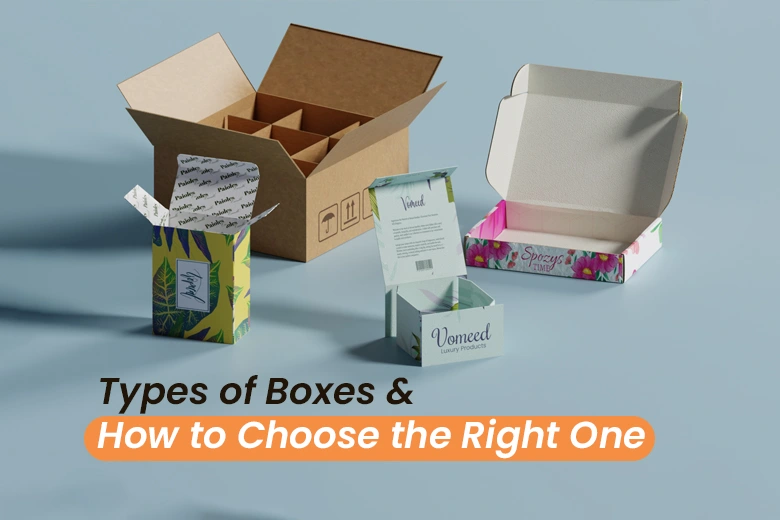
There are three core categories of boxes: corrugated boxes, folding cartons, and rigid boxes. Everything else- mailer boxes, display boxes, sleeve boxes- is built on top of these.
So instead of memorizing types, understand how they perform. That is what actually helps you choose.
Quick Decision Guide
If you just need a fast answer:
- Shipping → Corrugated boxes
- Retail shelves → Folding cartons
- Premium/luxury → Rigid boxes
- eCommerce → Mailer boxes
Anything outside this depends on weight, fragility, and presentation goals.
The 3 Main Categories of Boxes
Corrugated Boxes
If a product is being shipped, corrugated boxes are the default. Not because they look good, but because they survive pressure.
Corrugated cardboard is not just thick cardboard. It is built with flat linerboards and a fluted layer in between. That fluted layer creates air pockets, which absorb impact and increase stacking strength.
That is what prevents collapse during transport.
But performance depends on structure, and this is where most people get it wrong.
Single-wall corrugated works for lighter loads and short distances. It is cost-effective, but once stacking pressure increases, it starts to fail.
Double-wall adds a second fluted layer, increasing compression strength. This matters in warehouses, where boxes are stacked and bottom layers carry the load.
Triple-wall is used in industrial shipping. Not common in eCommerce, but necessary for heavy or high-risk loads.
Most shipping boxes use B-flute or C-flute:
- C-flute → better cushioning and stacking strength
- B-flute → thinner profile, better for printing and tighter packing
Strength is also measured using ECT (Edge Crush Test), which indicates how much vertical load a box can handle before collapsing.
And here is what most content ignores:
Most shipping damage does not come from drops; it comes from compression during stacking.
Corrugated solves that problem, but it creates another one. Compared to folding cartons or rigid boxes, corrugated looks rough and less refined. Print quality is lower, and visually it feels disposable.
So the trade-off is clear:
You gain protection, but lose presentation.
Folding Cartons (Paperboard Boxes)
Walk into any store, these are everywhere. Folding cartons are made from paperboard, which is lightweight, smooth, and easy to print on. That is why they dominate retail packaging.
They ship flat, which reduces storage costs. Once assembled, they hold shape well enough for lightweight products. That makes them efficient at scale. But structurally, they are limited.
Paperboard does not absorb impact like corrugated. It bends under pressure and deforms under weight. So while they outperform corrugated in branding, they fall behind in protection.
That is the trade-off:
They help sell the product, but when pressure builds, they do not hold up the same way.
On a retail shelf, that is usually fine. Everything is controlled. Nothing is really testing the packaging. Shipping is a different story. Weight, movement, rough handling- it adds up fast. And that is where things start going wrong, especially with heavy or fragile items.
Rigid Boxes (Set-Up Boxes)
Rigid boxes do not fold. They are pre-assembled and hold their shape regardless of pressure.
That is why they feel different. Rigid boxes are used for products where perception matters- electronics, jewelry, premium gifts- because they change how the product is experienced before it’s even opened.
Unlike folding cartons, they do not rely on assembly for structure. Unlike corrugated cardboard, they do not flex or feel disposable. However, they signal value immediately.
But that comes at the expense of:
- Higher production cost
- More storage space required
- Increased shipping volume before use
That is why they are not used at scale for low-cost products.
They are a strategic choice, not a default one.
Common Types of Boxes by Structure
Structure determines how a box closes, how it handles pressure, and how easy it is to assemble.
Regular Slotted Container (RSC)
It is the standard shipping box. All its flaps meet in the center, balancing strength and material use. Reliable, cost-efficient, and widely used.
Half Slotted Container (HSC)
It is the same as RSC, but without top flaps. It is useful for storage and quick access. But removing the top reduces protection significantly.
Full Overlap (FOL)
Flaps fully overlap when closed. More material, but also more strength. It is better for rough handling and heavy loads.
Mailer Boxes
Widely used in eCommerce. They fold into shape without tape, which makes packing faster and cleaner. They also offer better branding than standard shipping boxes.
But they also have limits. Push weight too far and they fail faster than corrugated RSC boxes.
Tuck-End Boxes
Tuck end boxes are simple retail packaging. Easy to assemble, low in cost, widely used. But they are not built for protection.
Auto-Lock Bottom Boxes
These boxes are designed for speed. The base locks automatically, reducing packing time in high-volume operations. They also support more weight than standard tuck-end designs.
Sleeve Boxes
They have a tray combined with an outer sleeve. Adds a layer of presentation without going fully rigid.
Gable Boxes
These boxes come with handles. Used in food packaging for convenience not protection.
Display Boxes
Crafted for shelf visibility. They improve product exposure but sacrifice durability.
Window Boxes
They allow product visibility but reduce protection from dust, light, and air.
Two-Piece Boxes
They have separate lid and base. Common in premium packaging because they improve the unboxing experience.
Die-Cut Boxes
Custom-shaped to fit products precisely. Reduce movement, but increase cost.
Pizza Boxes
Flat, ventilated, designed to manage heat and moisture.
Archive & Moving Boxes
Built for stacking, durability, and transport. Not designed for presentation, only performance.
Types of Boxes by Material
| Material | Strength | Branding | Use Case |
| Corrugated | High | Low | Shipping |
| Paperboard | Low | High | Retail |
| Kraft | Medium | Medium | Eco-packaging |
| Rigid | High | High | Luxury |
| Plastic | High | Low | Waterproof needs |
| Wood | Very high | Low | Heavy loads |
| Metal | Extreme | Low | Industrial |
| Acrylic | Low | High | Display |
| Fabric | None | High | Premium Finishes |
Please note that: Kraft is not a separate box type. It is a paper material used to make corrugated boxes, folding cartons, and mailer boxes, mainly when strength and eco-friendliness are priorities.
No material is perfect, only optimized for a specific use.
Types of Boxes by Use Case
Shipping
If your product is moving through a supply chain, you are not choosing a box, you are choosing how much damage you are willing to tolerate.
Corrugated boxes dominate here for a reason. They handle pressure, stacking, and rough handling better than anything else at scale.
But here is where most decisions go wrong:
People choose based on weight. They should be choosing based on stacking pressure. A lightweight product stacked under 20 boxes will fail faster than a heavy product shipped alone.
So the real decision looks like this:
- Low stacking, short distance → single-wall works
- High stacking or warehouse storage → double-wall becomes necessary
- Fragile product → strength alone is useless without inserts
If you ignore internal movement, even the strongest box will not save your product.
Retail Shelves
Retail packaging is not about protection. It is about convincing someone to pick the product up.
Folding cartons dominate because they are lightweight, clean, and print extremely well.
But they only work because retail environments are controlled:
- Minimal stacking pressure
- Limited handling
- Predictable storage
The moment those conditions break during transport or poor handling, folding cartons fail quickly.
So the rule is simple:
Use folding cartons to sell the product. Do not expect them to protect it.
eCommerce
eCommerce sits in an awkward middle ground.
You need protection like shipping, but presentation still matters because the customer experiences the product at home.
Mailer boxes exist because they balance both.
They are:
- Faster to assemble
- Cleaner in presentation
- Better for branding than standard corrugated
But they are not a replacement for shipping-grade strength. Push weight too far, and they fail, quietly, through bending and deformation, not dramatic breakage.
If the product is even slightly heavy or fragile, you either:
- Reinforce the mailer, or
- Move to corrugated entirely
Trying to stretch a mailer beyond its limits is where most eCommerce damage starts.
Fragile Products
This is where most people misunderstand packaging completely.
They focus on the box, and the box alone is not the solution. Movement is the problem. A fragile product breaks because it shifts inside the box not because the outer wall failed.
That means:
- Corrugated strength is necessary
- But inserts are what actually prevent damage
Foam, partitions, die-cut supports- they control movement.
Without them, you are just giving the product more room to break.
Luxury Products
Luxury packaging is not about protection. It is about perception before interaction.
Rigid boxes exist to create that moment. They:
- Hold shape permanently
- Feel substantial in hand
- Signal value before the product is seen
But they are expensive in every way:
- Production cost
- Storage space
- Shipping volume
So if your product does not rely on perceived value to justify its price, rigid packaging becomes waste not strategy.
Storage & Moving
This is the simplest use case and the one people still overcomplicate.
Nothing matters here except durability and stacking strength.
Not branding.
Not a presentation.
Not unboxing.
Corrugated boxes designed for compression and repeat handling are the only logical choice.
How to Choose the Right Box?
Stop thinking in categories. Start thinking in constraints.
Every packaging decision is give and take. You are balancing forces that work against each other: protection against cost, presentation against durability, storage against convenience.
The right box is not the one that does everything well. It is the one that fails the least where it matters most.
Start with weight, but do not stop at the number. A box is rarely carrying just the product, it is carrying everything stacked on top of it. If you ignore stacking pressure, you will underestimate the strength required.
Then look inside the box. If the product can move, it will. And once it moves, damage becomes a matter of time. Strength alone does not fix that, but control does.
Distance changes everything. The longer the journey, the more handling, vibration, and compression the box has to survive. What works locally often fails in transit.
Now consider the presentation. If packaging influences buying decisions, material and finish matter. If it does not, then spending on appearance is a wasted margin.
Operational reality matters just as much. A box that slows down packing at scale will cost more over time than a slightly more expensive structure that speeds things up. The same applies to storage: flat-packed efficiency versus pre-assembled convenience.
Most packaging failures are not material failures. They are decision failures, usually from optimizing one factor while ignoring the rest.
Quick Comparison
| Box type | Best For | Protection | branding | cost |
| Corrugated | Shipping | high | low | low |
| Folding Carton | Retail | low | high | low |
| Rigid | Luxury | high | high | high |
| Mailer | ecommerce | medium | medium | medium |
FAQs
Which box is best for eCommerce shipping?
Mailer boxes for lightweight products. Corrugated boxes for heavier or fragile shipments.
What are double-wall boxes?
Double-wall has two fluted layers, increasing stacking strength and durability.
Are rigid boxes worth the cost?
Only when presentation directly impacts perceived value, like luxury or gifting.
How do I choose the right box strength?
Look at weight, stacking conditions, and ECT rating. Remember, strength is about compression, not just thickness.
What causes most shipping damage?
Compression from stacking, not drops.
What type of box is best for fragile items?
Double-wall corrugated with internal inserts.
Final Thought
Box types are not categories; they are decisions under constraints.
Protection, cost, presentation, and logistics all compete. The right box is not the strongest or the cheapest; it is the one that fits how your product moves, how it is handled, and how you want it to be perceived.
Get that balance wrong, and packaging stops helping and starts costing you.