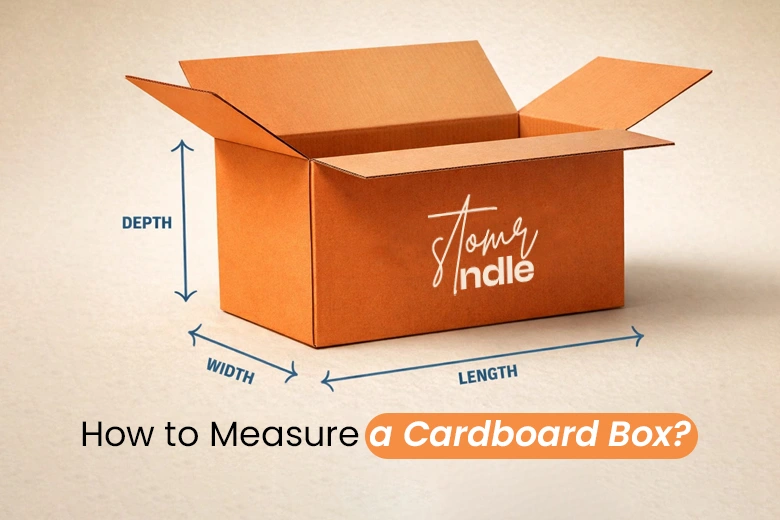
Choosing the right cardboard box size is not always as simple as it looks. If a box is too small, your product may not fit properly. If it is too large, items may move around during shipping and get damaged. This is why it has become extremely important to learn how to measure a cardboard box correctly for businesses, warehouse teams, and even individuals sending packages.
Right box measurements keep your products secure from damage, reduce shipping costs, and improve storage efficiency. They also make it easier to order the right packaging from suppliers or design custom packaging for your products. The good news is that measuring a cardboard box is not complicated. Once you understand the basic dimensions and the correct order of measurement, the process becomes very simple.
In this guide, we have explained everything in easy steps so you can measure a cardboard box correctly. Read more to learn!
What Tools Are Needed to Measure a Cardboard Box?
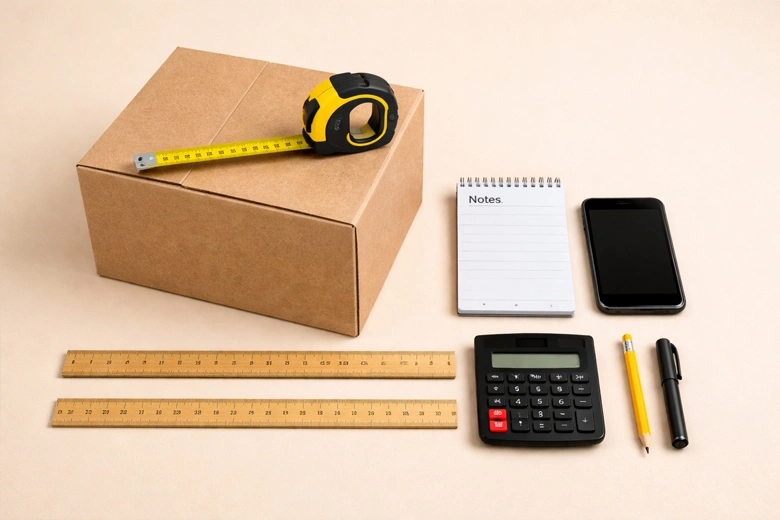
You do not need specialized equipment to measure a cardboard box. In most situations, a few simple tools are enough to complete the task accurately.
The most commonly used tools include:
- A measuring tape is ideal for measuring medium and large boxes.
- A ruler or yardstick is useful for smaller packaging boxes.
- A Notepad or digital device helps record measurements so you do not forget them.
- The calculator is optional, but it is useful if you need to calculate box volume or shipping dimensions.
- A pencil or marker is helpful for marking points while measuring.
Having these tools ready before starting makes the measurement procedure fast and precise.
What Are the Three Measuring Dimensions of the Box?
Every cardboard box is described using three standard dimensions. These measurements indicate the internal space of the box and help determine whether a product will fit properly inside it.
The three main box dimensions are:
- Length is the longest side of the box opening
- Width refers to the shorter edge across the box opening.
- Height (Depth) measures the vertical distance from the base of the box up to the top opening.
These measurements are written in the following order:
Length × Width × Height
Packaging manufacturers and shipping companies follow this standard format, so keeping the correct order is important when ordering boxes or calculating shipping costs.
How to Measure the Length of a Cardboard Box?
Length refers to the longest side of the box opening. It is always measured first when determining box dimensions.
Steps to Measure the Length
- Open the box so the top opening is clearly visible.
- Look at the two horizontal sides of the opening.
- Identify which side is longer.
- Place your measuring tape along this side.
- Measure from one inner edge to the other and record the result.
For example, if the longest side measures 18 inches, then the box length is 18 inches.
It is recommended to measure from the inside edges of the box because most packaging suppliers provide box sizes based on internal dimensions.
How to Measure the Width of a Cardboard Box?
Width is the shorter side of the box opening. It is always measured after the length.
Steps to Measure the Width
- Look at the box opening again.
- Identify the shorter side of the opening.
- Place the measuring tape from one inner edge to the other.
- Record the measurement.
For example, if the shorter side measures 12 inches, then the width of the box is 12 inches.
Length will always be the longer side of the opening, while width represents the shorter side.
How to Measure the Height (Depth) of a Cardboard Box?
Height, also known as depth. It refers to the vertical distance from the bottom of the box to the top opening. This measurement determines how tall the box is and how much vertical space is available for the product.
Steps to Measure the Height
- Place the box upright on a flat surface.
- Position the measuring tape at the bottom inside corner of the box.
- Extend the tape upward until you reach the top edge.
- Record the measurement.
For example, if the measurement from the bottom to the top edge is 10 inches, then the box height is 10 inches.
Final dimensions: Length × Width × Height → 18 × 12 × 10.
How to Measure Interior vs Exterior Dimensions of the Box?
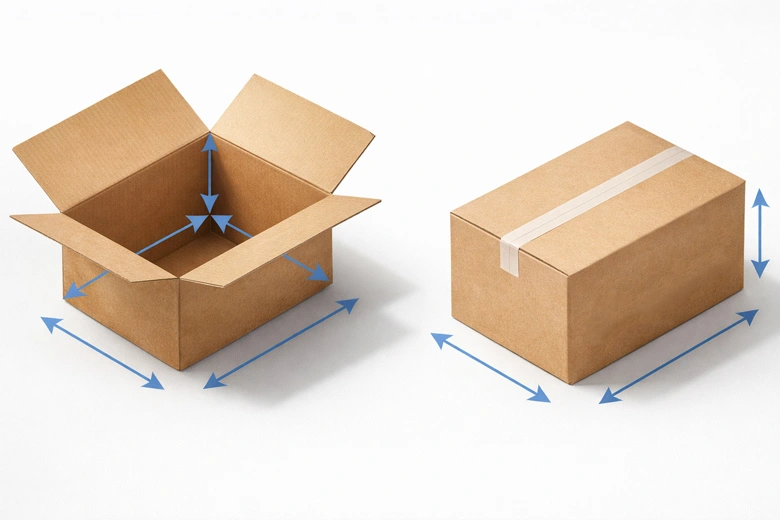
It is very important to understand that the interior and exterior box dimensions are different things before selecting packaging. Interior dimensions refer to the usable space inside the box where products are placed. Most packaging manufacturers use these as they show the actual space available for items and protective materials.
On the other side, exterior dimensions represent the measurements of the box from the outside. These dimensions include the thickness of the cardboard walls. Since corrugated cardboard has multiple layers, the exterior size of the box is usually slightly larger than the interior size.
Interior dimensions are most important when determining whether a product will fit inside a box. Exterior dimensions are commonly used for shipping calculations, warehouse storage planning, and pallet stacking.
Knowing the difference between these two measurement types helps businesses choose the correct box size and avoid packaging mistakes.
How To Calculate Box Volume?
Calculating box volume helps you understand how much space your box holds. Use this formula to measure the volume of your box.
Formula:
Volume = Length x width x height
Considering the example of the above measurement, the volume of the box will be.
Volume= 18 x 10 x 12 = 2160 cubic inches
Knowing the box volume is useful for storage planning, shipping calculations, and choosing the right packaging material.
Dimensional Weight And Shipping Weight
Shipping companies like UPS and FedEx often charge based on dimensional weight (DIM weight), which considers the space a box occupies rather than its actual weight.
Formula:
DIM (weight)= Box volume/ DIM divisor
Commonly, for UPS/ FedEx, the DIM divisor used is 139.
Let us take the same measurement mentioned above,z DIM weight becomes:
DIM weight = 2160/ 139 15.5 lbs
Tip: Always check DIM weight before shipping to avoid unexpected charges.
Box Measurement for UPS/FedEx
When shipping:
- Measure Length x weight x height using internal dimensions
- Round each measure up to the nearest inch.
- Use the DIM weight formula for large or overweight boxes.
- Use actual Vs DIM weight, you will be charged whichever is higher.
How to Measure Irregular Boxes
Irregular boxes may have non-uniform shapes (trapezoid, hexagon, or custom die-cut).
Steps:
- Identify the longest, shortest, and tallest points.
- Measure multiple sections if the box isn’t uniform.
- Use the largest measurement for shipping calculations.
For odd shapes, consider packing the product in a rectangular mailer to simplify the DIM weight.
What Are the Types and Grades of Corrugated Cardboard?
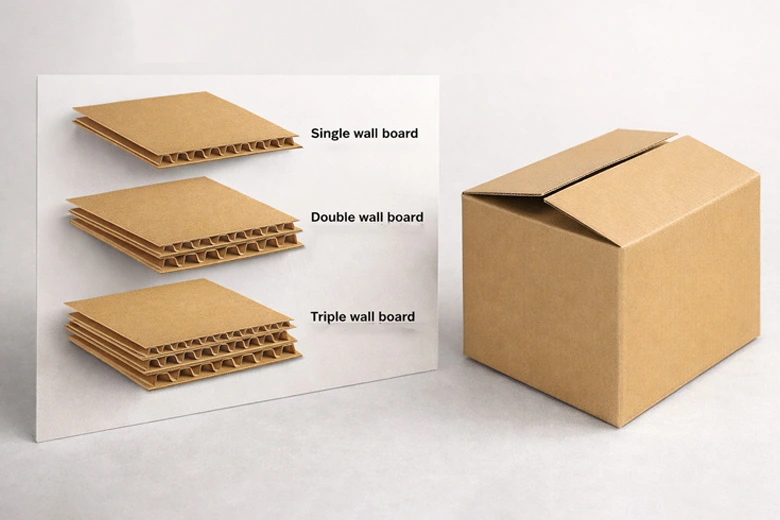
Corrugated cardboard is widely used in packaging because it offers strength, durability, and lightweight protection. It consists of a fluted layer placed between flat linerboards. The fluted middle layer acts as cushioning, which protects products during transportation.
Different grades of corrugated cardboard are used depending on the weight and fragility of the product being packaged.
Single-wall corrugated cardboard is the most commonly used option. It contains one fluted layer between two linerboards and is suitable for everyday shipping needs such as clothing, books, and lightweight retail items.
Double-wall corrugated cardboard contains two fluted layers and three linerboards. This construction provides extra strength and durability, making it ideal for heavier items or products that require additional protection during shipping.
Triple-wall corrugated cardboard is even stronger and is typically used for industrial packaging. It contains three layers of fluting and is designed to handle extremely heavy products, including machinery components and large industrial parts.
Understanding these grades helps businesses choose the right packaging material for product safety and transportation.
What Does Multiscore Box Mean?
A multiscore box is a cardboard box that includes multiple crease lines along its sides. These score lines allow the box to be folded at different heights, making it adjustable for different product sizes.
This design offers flexibility because a single box can be used for products with different heights. Instead of purchasing multiple box sizes, businesses can simply adjust the height of the box by folding it along the desired score line.
Multiscore boxes are commonly used in warehouses, distribution centers, and e-commerce fulfillment operations where packaging efficiency is important. They help reduce packaging inventory while providing greater flexibility during packing.
What Are Popular Box Type Options for Different Products?
There are many types of cardboard boxes available, and each one is designed for specific packaging needs. Choosing the right box type helps protect products and ensures efficient shipping.
Standard Single Wall Boxes
Standard single wall boxes are the most widely used shipping boxes. They are commonly designed as regular slotted containers where the flaps meet in the center when the box is closed. These boxes are lightweight and cost-effective, which makes them suitable for everyday shipping needs. Businesses often use them for packaging clothing, books, household products, cosmetics, and many other retail items.
Double Wall Boxes
Double wall boxes are designed for heavier or more fragile products that require extra protection. Because they contain two layers of corrugated board, they provide greater strength and durability compared to single wall boxes. These boxes are often used for shipping electronics, glassware, tools, and bulk items that may experience rough handling during transportation.
Eco-Friendly Die-Cut Boxes
Eco-friendly die-cut boxes are custom-shaped packaging boxes produced using specialized cutting dies. These boxes are commonly used in e-commerce packaging because they can be designed in unique shapes that fit products perfectly. Many brands use die-cut mailer boxes for subscription services, cosmetic boxes, gift boxes, and electronic accessories. They are often made from recyclable materials, making them a popular option for brands focusing on sustainable packaging solutions.
Tips to Measure a Box
Accurate measurements are important when selecting or ordering packaging. Small mistakes in measurement can lead to incorrect box sizes and increased shipping costs.
It is always best to measure the inside of the box because most packaging suppliers use interior dimensions when listing box sizes. Following the correct dimension order that is length, width, and height is also important to avoid confusion.
Always place the box on a flat surface to get an accurate measurement. If the box is uneven or folded incorrectly, the measurements may not be correct. It is also a good idea to leave a little extra space when selecting a box so that protective packaging materials such as bubble wrap or foam inserts can be added if needed.
Another useful tip is to measure the box twice before finalizing the dimensions. Double-checking measurements helps avoid errors when ordering packaging or calculating shipping costs.
Conclusion
Measuring a cardboard box correctly is an important step in packaging, shipping, and storage. Accurate box measurements make sure that products fit properly, remain protected during transportation, and do not get you unnecessary shipping costs. Businesses that understand box dimensions can also improve packaging efficiency and reduce material waste.
By following the steps and tips explained in this guide, measuring a cardboard box becomes quick and accurate. Whether you are packing products for shipping, ordering custom packaging, or managing warehouse storage, these measurement techniques will help you choose the right box every time.
FAQs
Q1. What is the correct order to measure a cardboard box?
The correct order is Length × Width × Height (L × W × H). Length is the longest side, width is the shorter side, and height is measured from bottom to top.
Q2. Should you measure the inside or outside of a cardboard box?
Boxes are usually measured using interior dimensions because they show the actual space available for the product.
Q3. Why are accurate box measurements important for shipping?
Accurate measurements help avoid extra shipping costs and make sure products fit properly and stay protected during transit.
Q4. How do you measure an irregular-shaped box?
Measure the longest, widest, and tallest points of the package and use these maximum dimensions for shipping calculations.